
The Rainbow in Genesis 9: Covenant, Mercy, and Divine Promise
In Genesis chapter 9, the rainbow appears, following the catastrophic ‘Great Flood’ that wiped out a corrupt and violent humanity. With this, God establishes a new covenant with Noah and, by extension, with all living creatures and the earth itself:
“I establish my covenant with you: Never again will all life be destroyed by the waters of a flood; never again will there be a flood to destroy the earth.” And God said, “This is the sign of the covenant I am making between me and you and every living creature with you, a covenant for all generations to come: I have set my rainbow in the clouds, and it will be the sign of the covenant between me and the earth.” (Genesis 9:11-13, NIV)
The rainbow is not merely decorative or a meteorological phenomenon to be admired. Beyond even being symbolic, it serves as a visible, permanent token of God’s restraint and mercy. One from which we should find great gratitude.
After judging a world steeped in wickedness (Genesis 6:5-7), God chooses to preserve life and bind Himself to a promise of stability.
I have heard it be said that ‘the bow, often understood in ancient Near Eastern context as a weapon of war, now hangs unstrung in the sky, pointed away from the earth, signifying that divine judgment by water has been set aside’.
The colors span the spectrum of light, reminding humanity of the order restored after chaos, of creation’s renewal, and of God’s faithfulness, even when humanity remains flawed (Genesis 8:21).
This covenant is universal, i.e. not limited to any particular people. It encompasses “every living creature” and underscores themes central to the Biblical worldview: human dignity (made in God’s image, Genesis 9:6), the value of life, the regularity of seasons and natural order, and the reality of both judgment and grace, male and female. The rainbow, therefore, points to God’s sovereignty over creation and His commitment to patience with a rebellious world.
Which brings us to the following…
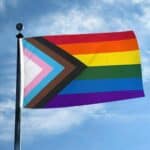
Cultural Subversion and the Pride Flag
In recent decades, the rainbow has been deliberately repurposed as the central symbol of the LGBT movement, particularly through the rainbow flag (often called the Pride flag) and its many variants. What began as a laudable symbol for gay rights has expanded to represent a broader spectrum of sexual and gender identities. To the point where the flag (as shown above) doesn’t even have the full colour spectrum of the rainbow on it.
Annual Pride events celebrate this symbolism with parades, idiologically captured corporate endorsements, and excessive cultural dominance in much of the West.
From a traditional biblical perspective, this represents a profound subversion. The original Genesis rainbow is a sign of God’s covenantal faithfulness and a reminder of humanity’s need for moral order after near-total destruction due to unchecked sin. The modern Pride rainbow, by contrast, is frequently deployed in direct opposition to Biblical sexual ethics.
Scripture consistently presents sexual intimacy as ordered within the covenant of male-female marriage (Genesis 1-2, Matthew 19:4-6), while viewing homosexual practice as contrary to God’s design (Leviticus 18:22, Romans 1:26-27). The adoption of the rainbow reframes human autonomy and sexual self-expression as the highest good, often explicitly rejecting traditional religious authority.
Reminiscent of “Do what thou wilt shall be the whole of the Law” central tenet of Thelema, a philosophy founded by Aleister Crowley.
Even the language of “Pride” itself carries heavy theological irony. In Christian theology, pride (Latin superbia) is not a virtue but the root sin, the elevation of self over God, the refusal to submit to the Creator’s order. Proverbs 16:18 warns that “pride goes before destruction,” and the New Testament calls believers to humility and repentance rather than self-celebration in defiance of divine standards.
As Matt Walsh said:
“Pride month is a celebration of vanity and narcissism. Saner a societies considered pride a vice. We dedicate an entire month to it”
And of course, we do not believe in essentialising entire groups of people that are lesbian, gay, bisexual or trans. Many of them object to the activism that is carried out in their name. The purpose of this analysis here is to call out the nature of the activism which evidently spits on Christianity by subverting, perverting or rather inverting one of its oldest tokens and symbols. The rainbow.
The Genesis flood narrative itself is preceded by a world where “every inclination of the thoughts of the human heart was only evil all the time” (Genesis 6:5). The rainbow memorializes God’s mercy despite that reality, not an endorsement of continued rebellion.
Critics of this cultural shift argue that the LGBT activism movement has not merely borrowed a colorful motif but has consciously inverted its meaning: from a sign of divine sovereignty and human limitation to a banner of human sovereignty and liberation from divine limits.
Major institutions, corporations, schools, governments, and media, now fly the Pride flag prominently during June, often pressuring conformity while sidelining or mocking biblical perspectives. This is seen by many religious observers as a form of cultural idolatry, replacing worship of the Creator with celebration of created desires.
Where the biblical rainbow calls humanity to remember God’s patience and live accordingly, the Pride rainbow is often accompanied by messages that dismiss or rewrite scriptural teaching on sexuality as outdated or oppressive.
This subversion fits a broader pattern in late-modern culture: the re-sacralization of symbols for new ideological purposes. Just as revolutionary movements have historically co-opted Christian symbols (the inverted cross, for example), the rainbow flag transforms a sign of covenant fidelity into one of autonomy and transgression.
Supporters frame this as progress, inclusion, and resistance to bigotry. Traditional believers see it as a tragic turning away—literally “turning its back on God”—echoing the cycles of rebellion and judgment found throughout the Bible.
Conclusion
The rainbow of Genesis 9 stands as a quiet but powerful witness: a multicolored reminder in the sky that God judges sin, yet extends mercy and maintains the world despite human fallenness. It calls for gratitude, humility, and moral responsibility.
Its modern co-option by the LGBT Pride movement illustrates how powerful symbols can be detached from their historical and theological roots and pressed into service for an opposing worldview, one centered on self-definition, sexual liberation, and rejection of transcendent moral order.
Whether one views this shift as cultural evolution or spiritual subversion depends on one’s starting assumptions about God, Scripture, and human nature. For those who take Genesis seriously, the rainbow still speaks in the clouds today.
It asks whether we will remember the covenant or continue the pattern that made the Flood necessary in the first place. In an age of competing symbols and loyalties, the original meaning endures for those willing to look upward.
– BrandX