
The phrase “fifth column” evokes images of betrayal, secrecy, and subversion. It refers to a group of people who secretly work against their own nation, organization, or community from the inside, often in coordination with an external enemy. Far more insidious than open opposition, a fifth column undermines morale, spreads disinformation, sabotages efforts, and prepares the ground for external forces to triumph. The term has become a powerful metaphor in politics, military history, and security discourse for the danger of internal division.
Origins in the Spanish Civil War
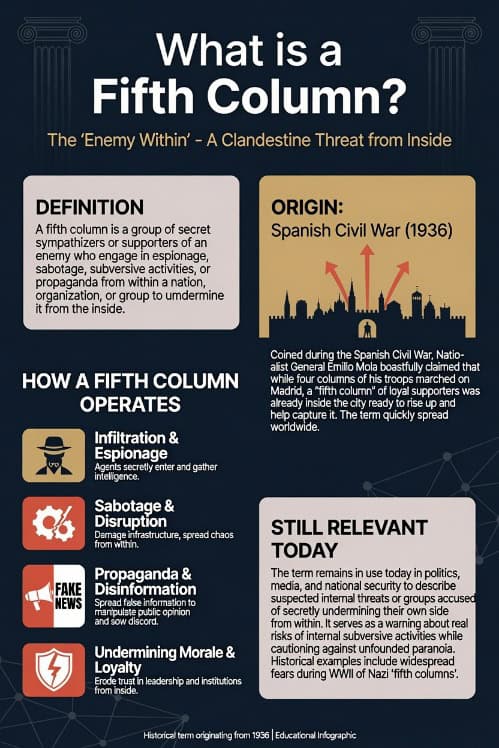
The expression “fifth column” (quinta columna in Spanish) was born amid the chaos of the Spanish Civil War (1936–1939). As Nationalist forces under General Francisco Franco advanced on the Republican-held capital of Madrid, General Emilio Mola is credited with declaring that he had four military columns converging on the city—and a “fifth column” of sympathizers already inside its walls. These hidden supporters—sympathizers, agents, and infiltrators—would supposedly rise up at the critical moment to assist the attackers by sowing confusion, committing sabotage, and weakening defenses from within.
Though historians debate the exact speaker and precise wording, the phrase rapidly entered global vocabulary. Newspapers, radio broadcasts, and even literature (including Ernest Hemingway’s play The Fifth Column) helped popularise it. The concept resonated because it captured a timeless fear: the traitor in our midst is often more dangerous than the enemy at the gates.
How Fifth Columns Operate
A fifth column succeeds by exploiting trust and operating in the shadows. Its typical tactics include:
- Infiltration and Espionage: Placing agents or recruiting insiders who gain access to sensitive information, institutions, or decision-making circles.
- Sabotage and Disruption: Damaging infrastructure, supply lines, or operations to create chaos and erode capabilities.
- Propaganda and Disinformation: Spreading rumors, false narratives, and divisive messaging to undermine public confidence, fuel internal conflicts, and demoralize the population.
- Undermining Loyalty: Quietly eroding faith in leadership, institutions, and national unity, often by amplifying grievances or questioning the legitimacy of the defending side.
These activities are most effective when they remain deniable. The goal is rarely total destruction on their own, but rather to soften the target so an external force can deliver the decisive blow.
Historical Impact and Modern Echoes
During World War II, fears of fifth columns reached fever pitch. In the United States and Britain, concerns about Nazi sympathizers, fascist infiltrators, and even Japanese-American citizens led to heightened security measures, internment camps, and public vigilance campaigns. President Franklin D. Roosevelt warned explicitly of “the Trojan Horse. The Fifth Column that betrays a nation unprepared for treachery.”
The term has since been applied to a wide range of situations: suspected communist networks during the Cold War, alleged insider threats in corporate espionage, and contemporary political accusations of disloyalty. In today’s polarized environment, the label is sometimes invoked rhetorically to delegitimize opponents—turning a serious security concept into a tool of partisan attack. This misuse highlights an important caveat: while real internal subversion exists, the accusation of being a “fifth columnist” can also stifle legitimate dissent and foster paranoia.
Why the Concept Endures
The enduring power of the “fifth column” idea lies in its psychological truth. Societies and organizations are vulnerable precisely because they rely on internal cohesion and trust. When that trust is weaponized—whether through ideological extremism, foreign influence operations, cyber-enabled sabotage, or coordinated disinformation campaigns—the damage can be profound. In an era of social media, hybrid warfare, and global connectivity, fifth-column-style threats have evolved but have not disappeared.
The infographic accompanying this essay distills these ideas into a clear visual format: the definition, the dramatic Spanish Civil War origin story with its iconic four-plus-one column imagery, the operational tactics, and a reminder of the term’s continued relevance. It serves as both an educational tool and a warning.
Ultimately, recognizing the possibility of a fifth column does not mean succumbing to suspicion of every fellow citizen. Rather, it underscores the importance of vigilance, resilient institutions, shared values, and the careful protection of unity—without sacrificing the openness and freedom that make societies worth defending. In history and in the present, the most dangerous columns are often the ones already inside the walls.
– BrandX